
ROBERT CARVER
Writer & Trader
The Art and Science of Trading
How to combine intuition and rules when trading globally in equities, ETFs and crypto
By Robert Carver.
Preface

Is trading an art or a science?
As with any good question, the answer is not a straight yes or no; it depends. Some very gifted traders are definitely artists. They might read voraciously, devouring financial news, macroeconomic data and company reports, and then sit deep in thought for weeks on end before opening their laptops to trade. Or they might just stare at a price chart for a few hours, and then decide to purchase a particular stock. Which subsequently – surprisingly often – goes up. And they can’t really explain why they bought that specific stock at that exact moment; they just knew it would go up. Seeing them trade is just like watching a naturally gifted artist paint. Their trading is discretionary in nature.
Other traders are more like scientists. They may even have a PhD in physics, or another highly mathematical discipline. Some are literally former rocket scientists. They use their scientific knowledge to build computer systems that consume gigabytes of quantified financial data, pushing it through carefully tested and calibrated strategies running on powerful computers, which then decide when to buy and sell.1 The whole trading process is fully automatic. There is no artistry on display here – just banks of blinking lights on computer servers. Scientific trading is purely systematic, with no room for human judgement.
There are good and bad artistic traders, but there are also successful and unsuccessful scientific ones. And among the very best traders in the world, you will find both discretionary artists and systematic scientists. What, then, distinguishes good traders – of either variety – from bad ones? Simply put, good traders all follow certain rules.
What might surprise you is that the key rules are virtually the same for all outstanding traders, regardless of their preference for intuition or algorithms. These rules are scientific – they are underpinned by the mathematics and financial theory which systematic traders are well versed in. But profitable artistic traders also follow the same rules. They won’t always be conscious of this, but if you examine their trading history carefully you can see the rules being followed. Discretionary traders may be unfamiliar with the fancy theory, but they still know the rules instinctively, having developed them through their own trading, or from being educated by more experienced traders.
In contrast, bad traders do not follow these rules. They use a curious mixture of gut feeling and half-baked pseudo-scientific methods which are at best unhelpful and at worst downright dangerous. Most of them will lose money, unless they are especially lucky. These lucky few will assume their success is down to ignoring the rules. They are wrong.
This book is about combining art and science. Part of a successful trading strategy can be purely artistic – down to your intuition. It could also be entirely scientific. But however you trade, you must always follow certain key, scientifically grounded rules.
I have learned and used these rules in my own trading career over nearly 30 years: initially as a clueless retail trader, then as a discretionary trader for an investment bank, and subsequently as a systematic portfolio manager for a multi-billion-dollar hedge fund. More recently, I have been managing my own capital again, where I predominantly employ systematic strategies with occasional forays into discretionary trading, marked by a touch of artistic flair.
If you do follow these rules, you will have a better chance of succeeding as a trader. Around 85% of retail (non-professional) traders lose money, so the odds are stacked against you. Following these rules will give you a fighting chance of being profitable. Whether you make a decent return will then depend on your own trading skills, and whether you are lucky.
This book is designed to be accessible, so that even relatively inexperienced traders can use it – and although it’s based on scientific principles, you do not need to be a genius to read it. I won’t be using any complex equations, and there is no need for sophisticated trading software. Implementing the rules in this book requires nothing more than some common sense, a spreadsheet, and a brokerage app or website to trade on.
I’m going to cover three different types of financial products in this book:
-
equities, also known as stocks or shares
-
cryptocurrencies (‘crypto’), like Bitcoin, Ethereum and the many thousands of ‘altcoins’ and ‘meme coins’
-
exchange-traded funds (ETFs), a way to access different asset classes and multiple instruments whilst trading in a single fund that behaves like a share.
I have chosen these products because they are accessible to almost anyone: they require relatively small amounts of cash to trade, and they are commonly used by retail traders. Later in the book, I will help you to work out which product will be most suitable, given your circumstances.
Like football, trading is a global sport. You will find this book helpful as long as you live in a country where trading is possible (and legal!). To save space, all the examples I give are for US markets. But the rules here are universal and can be applied to trading in almost any country. There are some specific issues to consider if you want to trade in certain jurisdictions, and I will discuss these. It’s nearly always possible to open a trading account with the equivalent of a few hundred US dollars, and that should be enough to start trading using the rules I outline in this book.
Who should read this book
How to use this book
The scientifically grounded rules in this book are designed to be used by traders of all kinds: artists and scientists. These rules are then combined with a trade opening method which determines when to buy. Methods can be of the discretionary flavour preferred by artistic traders, or the systematic variants favoured by disciples of science. Together, the rules and method make up a trading strategy.
How you use this book will depend on your current level of experience and preferences:
-
If you are relatively inexperienced and have no ideas about how to trade, you can use the suggested methods that I provide in the book as a starting point.
-
If you own other trading books, or have learned methods from trading experts that you would like to use, then feel free to do so. I will explain how to combine their methods with my trading rules, and where you should ignore their advice.
-
For those who are experienced traders: again, you can continue to use your own opening methods, except where they conflict with the rules in this book. But you must not mix and match, following some rules but not others; the rules are designed to work together.
This book is designed to help you as you progress through your trading career. You can begin by using my suggested methods, and then develop your own ideas or incorporate others from elsewhere. Novice traders should start with the relatively simple rules explained in the first two parts of the book. Then, when you have more experience, the later parts of the book explain how to adapt your simple trading strategies to make them more complex and increase their expected profitability.
If you do follow these rules, you will have a better chance of succeeding as a trader. Around 85% of retail (non-professional) traders lose money, so the odds are stacked against you. Following these rules will give you a fighting chance of being profitable. Whether you make a decent return will then depend on your own trading skills, and whether you are lucky.
Previous books
This is my fifth book. My previous volumes mostly cover fully systematic trading. They are also more advanced than this new book. So, if you have limited experience with trading, or have struggled with the content of my earlier work, then this is a good book to read first.
This book will also help if you have already had some exposure to my earlier writing, and have developed a dislike of pure systematic trading (for which I can only apologise). Instead, you have decided you would prefer to use the concept of semi-automatic trading: combining a core set of systematic trading rules with more subjective discretionary methods for predicting markets.
It will also be helpful to read this book if you are trading assets without leverage, like stocks, ETFs and crypto. My other books mostly assume that you are trading leveraged instruments. There are some additional complexities if you don’t have access to leverage, which I cover here in detail. I also strongly suggest that newcomers to the markets initially trade without leverage, as it’s much safer. Again, this would suggest that this book is a good starting point.
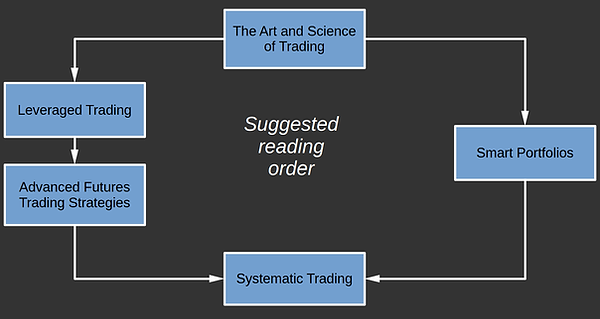
To summarise, a suggested reading order for my books is:
1. This book, The Art and Science of Trading: an accessible guide to trading without leverage, using a combination of scientific rules and artistic discretion.
And then either:
2. Leveraged Trading: a relatively accessible book on trading with leverage, using both semi-automatic and purely systematic trading strategies, followed by:
3. Advanced Futures Trading Strategies: a guide to trading futures (a leveraged financial instrument) which includes over 30 purely systematic strategies.
Or alternatively, if you would prefer to trade without leverage, and at a relatively slow speed:
4. Smart Portfolios: a book on investing2 without leverage, using systematic rules.
Then, finally:
5. Systematic Trading: a relatively advanced book on designing systematic trading strategies from scratch, both with and without leverage. This book also includes content on semi-automatic trading.
What is in the book
The book begins with an introduction, which discusses when we need to behave like scientists when trading, and how we should do so. Then part one explains how to prepare for trading, making key decisions about brokers, instrument choice and opening methods. Part one also includes detail on the calculation of trading costs and the sizing of positions – two important, and often overlooked, parts of designing good trading strategies.
In part two, I introduce the core trading rules that are required for any strategy, explaining how to open and size positions, and when to close them. I also introduce a simple opening method that can be used as a starting point for inexperienced traders. The final chapter in part two explains how to put methods and rules together in a complete trading strategy.
From part three onwards, I explain how to improve this simple strategy by diversifying it into trading multiple instruments, and also by expanding the universe of opening methods you can use. Part four discusses more advanced rules for managing your trades. Finally, part five explains how to record your trading, and how to analyse your trading history.
Appendix A lists some key resources, appendix B explains how to perform important trading-rule calculations in a spreadsheet, and appendix C has the relevant calculations for opening methods. In appendix D you will find details of the various instruments and data used in the book, and in appendix E I cover the assumptions I’ve used to calculate trading costs.